In the Name of Allāh, the Ever Merciful, the Bestower of Mercy
الحمد لله رب العالمين والصلاة والسلام على أشرف الأنبياء والمرسلين، سيدنا ونبينا محمد وعلى آله وصحبه أجمعين. وبعد:
I have seen that some people are rejoicing, boasting and exulting, over a young woman (Korra The Taymi, they call her), said to be nineteen years of age, who sat before a gathering of twenty Christian women and debated them. They claim she thoroughly defeated them, and they ask: what gave her such confidence? Then they answer: Due to Islām being the truth.
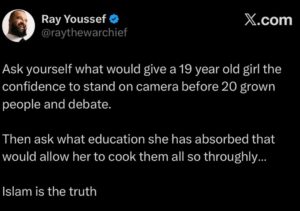
But I say that this rejoicing is misguided. The truth of Islām does not require a young woman to stand on a stage, before cameras and crowds, to be watched and praised. The truth of Islām is established by the Book and the Sunnah, not by the performance of a debater. And the one who celebrates this has departed from the way of the Salaf.
The Messenger (ﷺ) said: “The woman is ʿawrah. When she goes out, Shayṭān seeks her.” This is a sound ḥadīth3. The meaning is that her presence in a place where non-maḥram men (or even women who may describe her) can see her is a source of trial. The purpose of the Sharīʿah is to conceal the woman, to protect her, and to prevent her from becoming an object of gaze, discussion, and desire.
The Salaf (رحمهم الله) did not raise their daughters to be debaters. They raised them to be mothers, wives, and teachers from behind a veil. Our mother ʿĀʾishah (رضي الله عنها) was the most knowledgeable of women, yet she taught from behind a partition. She did not seek to be seen. She did not put herself on display for the sake of debate.
There is also a difference between a woman speaking out of necessity, where no man can do the task, or where the community requires her knowledge, and a woman making herself a public figure, seeking debates, cameras, and applause.
The first is permissible under conditions of necessity and security, and the second is a bidʿah. Our Messenger (ﷺ) did not command women to debate, nor did he praise them for seeking visibility. Rather, he said: “The best of your women are those who are affectionate and loving, who bear children, who are agreeable and supportive, provided they are mindful of Allāh. As for the worst of your women, they are those who display their beauty openly, take pride in their appearance, and are hypocritical. None of them will enter Paradise except in the rare manner that a red-beaked crow is seen (i.e., something extremely uncommon and rarely encountered).”4
As for the one who wears the niqāb and then appears on camera, debating, being watched, discussed, and celebrated, this is a contradiction. The niqāb is legislated to say: “I am not for your eyes.” But the debater is for the eyes of thousands. Her niqāb, then, becomes a costume, a brand, a prop. It is no longer an act of devotion but an instrument of attention.
This is the way of the charlatans who use the symbols of Islām for worldly gain. They wear the garment of piety while seeking the gaze of creation. And the naive ones applaud them, because they are seemingly articulate, because they are confident, because they make Muslims feel “victorious”. But “victory” that comes at the cost of violating the very purpose of ḥijāb is no victory at all.
From this platforming, several great evils arise:
Firstly, the young woman herself becomes a public figure. Her voice, her gestures, her words remain forever recorded. Every man who watches her, every woman who imitates her, every person who shares her videos, they all consume her image and her presence. And she will bear the weight of every eye that should not have fallen upon her.
Second, it teaches young Muslim women that their worth is in performance, articulation, and visibility. This is the logic of the West, not the logic of Islām. The West says: be seen, be heard, be famous. Islām says: be modest, be concealed, be protected.
Third, it diminishes the status of the ḥijāb. When a woman in niqāb is on camera, the niqāb no longer means “I am hidden.” It means “Look at me, I am the one who is hidden in plain sight.” This turns an act of obedience into a billboard.
Allāh (جل وعلا) said to the wives of our Messenger (عليه افضل الصلاة والسلام):
And stay in your homes, and do not display yourselves as in the days of ignorance Sūrat al-Rūm, 33:33.
The days of ignorance were when women walked unveiled, displaying their beauty. Islām came to conceal them.
The woman is ʿawrah, not because she is shameful, but because she is precious. And precious things are hidden, not displayed. A diamond in a glass case is looked at, admired, and forgotten. A diamond in a vault is protected and valued.
So I say to the ones who rejoice in such spectacles: fear Allāh. This is not the religion with which our Messenger Muhammad (ﷺ) was sent. This is not the way of the Salaf. This is a path that leads to visibility, to fame, to the loss of modesty, and to the corruption of women.
And I say to the young woman herself: seek to be hidden. Seek to be protected. Seek to be valued by Allāh, not by the crowds. Be that woman. Not the one on camera, but the one whose name is known only to those who love her and to her Lord.
We do not need more so-called female debaters. We need more mothers who raise their children on tawḥīd. We need more wives who are the hidden strength of their husbands. We need more women who are so covered, so concealed, that the world does not know them, but Allāh knows them, and He will honour them on the Day when no wealth and no children will avail, except one who comes to Allāh with a sound heart.
And Allāh knows best.
Written by Abū Dilāra Naief al-ʿAydarūs
Dhū al-Ḥijjah 01, 1447 | May 18, 2026
- Reported by al-Tirmidhi in al-Sunan (1173), Ibn Ḥibbān in Ṣaḥīḥ (5599), Ibn Khuzaymah in Ṣaḥīḥ (1685), and al-Ṭabarānī in al-Muʿjam al-Kabīr (10115) and al-Muʿjam al-Awsaṭ (8092). Graded as Ṣaḥīḥ by al-Tirmidhi, al-Dāraquṭnī in al-ʿIlal (5/315), Ibn Rajab in Fatḥ al-Bārī (5/318), and al-Albānī in Ṣaḥīḥ Sunan al-Tirmidhī (1/343) and Irwāʾ al-Ghalīl (1/203).
- Narrated by al-Bayhaqī in al-Sunan al-Kubrā (7/82). Graded as Ṣaḥīḥ by al-Albānī in al-Silsilah al-Ṣaḥīḥah (no. 1849).
- Reported by al-Tirmidhi in al-Sunan (1173), Ibn Ḥibbān in Ṣaḥīḥ (5599), Ibn Khuzaymah in Ṣaḥīḥ (1685), and al-Ṭabarānī in al-Muʿjam al-Kabīr (10115) and al-Muʿjam al-Awsaṭ (8092). Graded as Ṣaḥīḥ by al-Tirmidhi, al-Dāraquṭnī in al-ʿIlal (5/315), Ibn Rajab in Fatḥ al-Bārī (5/318), and al-Albānī in Ṣaḥīḥ Sunan al-Tirmidhī (1/343) and Irwāʾ al-Ghalīl (1/203).
- Narrated by al-Bayhaqī in al-Sunan al-Kubrā (7/82). Graded as Ṣaḥīḥ by al-Albānī in al-Silsilah al-Ṣaḥīḥah (no. 1849).




Gallery